
While President Donald Trump divided and advanced through an announcement aimed at warning pregnant women about possible links between the use of Tylenol and autism in children, his comments went beyond the available scientific evidence and even the language of their own health department.
He made it clear that he was aware that, sometimes, he was speaking for himself.
“You know, I’m just making these statements from me,” he said in a moment. “I am not doing them about these doctors, because when they talk about different results, different studies, I talk a lot about common sense.”
Trump’s comments deviated from the most measured orientation offered by their health agencies in subsequent press releases and opinion articles.
“Don’t take Tylenol,” he rumbled several times during the one -hour event on Tuesday.
“You’ll feel uncomfortable. It won’t be so easy, maybe. But don’t take it if you’re pregnant. Don’t take Tylenol,” he said.
In a Kenvue statement, the Tylenol manufacturer, the company said it believes that research shows that acetaminophen does not cause autism.

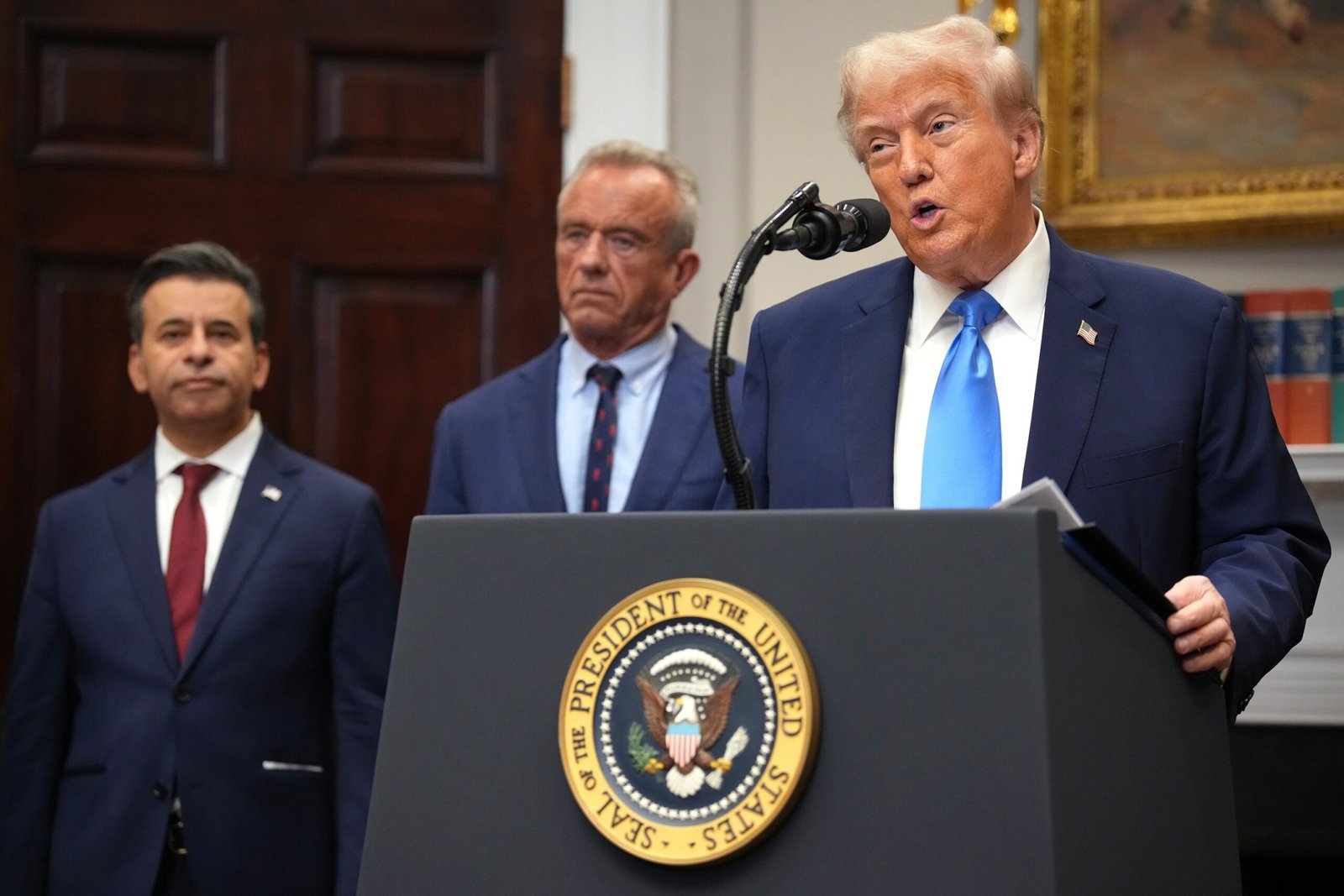
President Donald Trump accompanied by the Secretary of Health and Human Services Robert F. Kennedy Jr. and the Commissioner of the Food and Medicines Administration, Dr. Marty Makary, talks about autism in the White House in Washington, on September 22, 2025.
Andrew Harnik/Getty Images
“Otherwise, we disagree with any suggestion and we are deeply concerned about the health risk that this poses to wait for mothers,” reads the statement. “Acetaminophen is the safest analgesic option for pregnant women as necessary throughout their pregnancy. Without it, women face dangerous options: suffer conditions such as fever that are potentially harmful to both the mother and the baby or use more risky alternatives.”
The main medical groups immediately retreated Trump’s claims, noting that Tylenol is considered the only safe analgesic during pregnancy, and pointing out the possible dangers of pain and fever not treated during pregnancy, including a higher risk of fetal death.
Trump told pregnant women that they should “fight like hell not to take” the drug, it used to treat fevers in pregnant women, recognizing that “there may be a point where you have to do it and will have to solve it with themselves.”
However, as forceful and simple as Trump made it sound, evidence on Tylenol and autism is not yet completely formed, a fact declared by the Food and Medicines Administration in a press release on Tuesday.
“It is important to keep in mind that although an association between acetaminophen and neurological conditions has been described in many studies, a causal relationship has not been established and there are contrary studies in scientific literature,” said the agency in the press release, which announced that it would press a change of label for acetaminophen, the main ingredient of Tylenol.
Meanwhile, in a joint opinion article in Political, the FDA leaders, the National Health Institutes and the Medicare and Medicaid Services Center, wrote that “they recognize that literature continues to evolve and the evidence of family control studies has failed to find a correlation.”
“In addition, acetaminophen is the only free sale medicine approved to treat fevers during pregnancy, and high fevers in pregnant mothers can also represent a risk for their unborn child, as neural tube defects,” they added.
The American College of Obstetricians and Gynecologists (welcome) warned that administration’s claims were “irresponsible” and could scare away pregnant patients to take the medication, even when it is medically prudent.
“Today’s announcement for HHS is not backed by the full body of scientific evidence and dangerously simplifies the many and complex causes of neurological challenges in children. It is very disturbing that our federal health agencies are willing to make an announcement that will affect the health and well -being of millions of people without the reliable support of reliable data,” said Dr. Steven J. Fleischman, president of Welcomed.
Sometimes Tuesday, Trump suggested that children’s vaccines could contribute to autism, a theory promoted by its Secretary of Health, Robert F. Kennedy JR, but has been discredited by researchers.
“I’m not a doctor, but I’m giving my opinion,” he said.
“Vaccines do not cause autism,” reads a statement from the American Academy of Family Physicians following Trump’s comments. “Decades of rigorous research have not been able to provide credible scientific evidence that links vaccines with autism. Vaccines are among the most effective tools we have to keep people, especially babies and children, healthy and out of hospitals. The continuous statements about a vaccine-autism link public health risk by making people delay or differ the vaccine out of fear.”
